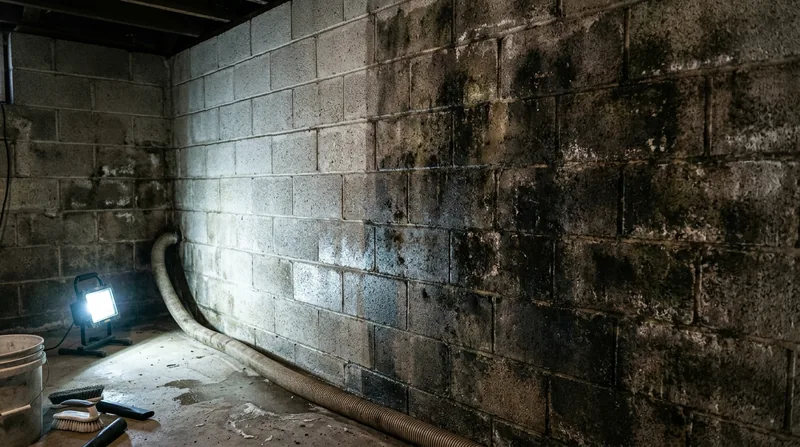




Basement Mold Remediation in Champaign: Fix the Moisture, Then the Mold
If you live in one of the 1900s-1930s bungalows on the Old West Side or a 1950s ranch in Bristol Park, you already know the pattern: spring rains soak the silty loam, the water table climbs, and suddenly your basement smells like a wet dog. Basement Mold Remediation in Champaign starts with finding the water source, not just spraying bleach on the wall. We treat the mold, but more importantly, we fix the drainage or humidity problem that let it grow. That is the only way to keep it from coming back. Call (217) 863-1605 for a free inspection and a straight answer on what your basement actually needs. For a broader look at how we keep water out, see our basement waterproofing service.
Why Champaign Basements Grow Mold: Flat Prairie, High Water Table, Old Stone Walls
Champaign sits on flat glacial till and silty loam that drains slowly. When the water table rises each spring, hydrostatic pressure pushes moisture through every crack and pore in old cut stone, brick, and early block foundations. Add Boneyard Creek rising fast during summer cloudbursts, and you have a recipe for damp walls and musty air. Most mold calls we get are not from a burst pipe; they are from chronic seepage that has been quietly feeding mold for years.
- Efflorescence and white salt deposits on the wall mean water is moving through the masonry right now.
- A musty smell in the basement usually points to mold growing behind drywall, under carpet, or in floor joists.
- Peeling paint and soft drywall at the base of the wall signal long-term moisture, not a one-time leak.
- Damp concrete floors and sweating pipes raise indoor humidity enough for mold to colonize stored items.
If you see any of these, the mold is a symptom, and the fix has to address the moisture source. The local building department can tell you what permits apply to structural or drainage changes, and rules vary by jurisdiction, so always verify before work starts. You can check the City of Champaign's official site for current permit guidance: City of Champaign.
Key info: A homeowner in Garden Hills called us about black mold on the lower block wall. The real problem was a failed footing drain that let water sit against the foundation all spring. We removed the mold, but the fix was an interior perimeter drain and a new sump basin. Without that, the mold would have been back by July.
How We Handle Basement Mold Remediation in Champaign: Contain, Treat, Dry, Prevent
Mold remediation is not a spray-and-walk-away job. We follow a sequence that protects the rest of the house and makes sure the mold does not return. First, we find the moisture source with a full basement inspection, including a musty smell diagnostic. Then we set up containment so spores do not spread to the living space. Only after that do we treat the affected surfaces and correct the underlying moisture problem.
- We inspect and diagnose the moisture source, checking walls, floors, joints, and humidity levels.
- We set up containment with plastic sheeting and negative air pressure to keep spores out of the rest of the house.
- We remove and treat affected materials, including porous items that cannot be saved and surface treatment on structural wood and masonry.
- We correct the moisture problem with drainage, sealing, or dehumidification, depending on what the inspection shows.
- We verify dryness with moisture readings before we close out the job.
For a free inspection that starts the process, visit our free basement inspection page.
Key info: A split-level home in Savoy had mold on the framed wall of a partly finished basement. The cause was a disconnected downspout that dumped roof water right at the foundation corner. We treated the mold, reconnected and extended the downspout, and added a dehumidifier set to 50 percent. No drainage excavation was needed.
Remediation Approaches We Use in Champaign Basements
Not every mold job needs the same tools. The right approach depends on how much mold is present, what it is growing on, and whether the moisture source is a one-time event or a chronic condition. Here is how we match the method to the problem.
| Approach | Description | Best for |
|---|---|---|
| Surface treatment and cleaning | We clean and treat mold on block, concrete, and joists with approved products. | Small areas of surface mold with a known, fixable moisture source. |
| Containment and removal | We seal off the work area, remove porous materials, and HEPA vacuum surfaces. | Larger growth on drywall, carpet, or stored items. |
| Drainage correction | We install or repair interior drain tile, sump pumps, or exterior drainage as needed. | Chronic seepage driven by hydrostatic pressure or a high water table. |
| Humidity control | We set up dehumidification and ventilation to keep basement air dry. | Damp basements with no single leak but consistently high humidity. |
| Wall sealing and vapor barrier | We seal walls and install vapor barriers to block moisture migration. | Porous masonry walls that wick moisture into the basement. |
Most Champaign jobs combine two or more of these approaches, because mold rarely has a single cause.
Basement Mold Remediation Cost in Champaign: What to Expect
Most basement mold remediation jobs in Champaign start around From $1,500, and that figure usually covers containment, treatment of affected surfaces, and a basic moisture correction. The final price depends on the square footage affected, whether porous materials like drywall or carpet have to be removed, and whether the underlying moisture problem needs drainage work. A small surface mold issue on a block wall is very different from mold behind finished drywall in a 1950s ranch.
We recommend getting two or three estimates so you can compare scope, not just price. A low bid that only sprays the mold without fixing the water source is not a real fix, and the mold will return the next time the water table rises. Ask each contractor what they will do about moisture, not just mold. For a detailed breakdown of what drives the number, see our pricing page.
What to Look for When Hiring a Basement Mold Remediation Contractor Near Champaign
Hiring the right contractor matters more here than in most trades, because a mold job done wrong can spread spores through the house. Start with licensed and insured status, and ask for a certificate of insurance before work begins. Get at least two or three written estimates with a clear scope, and ask for local references from Champaign or Urbana homeowners. If your home is in a historic district or has structural work planned, check with the city about permits, since rules vary by jurisdiction and must be verified.
Ask how the contractor will handle containment and whether they will correct the moisture source or just treat the mold. A contractor who does not ask about drainage, grading, or humidity is not solving the problem. When you are ready to talk, reach out through our contact page and we will set up a free inspection.
Basement Mold Remediation in Champaign: Pricing Guide
| Service | Price | Details |
|---|---|---|
| Surface mold treatment | Starting at $1,500 | Includes containment, surface treatment, and moisture source diagnosis for small areas. |
| Containment and removal | Starting at $2,500 | Covers removal of porous materials, HEPA vacuuming, and treatment of structural surfaces. |
| Mold plus drainage correction | Starting at $4,500 | Combines remediation with interior drain tile or sump work to stop chronic seepage. |
| Complex or large-scale job | On estimate | Finished basements with widespread growth need an on-site look before pricing. |
| Travel | Included | In Champaign and surrounding areas, no separate call-out or mileage fee. |
| Estimate | Free | Response within 24h at (217) 863-1605, no obligation to book. |
Indicative pricing, the exact cost depends on square footage, finish, and site access. Free personalized estimate within 24h at (217) 863-1605.


