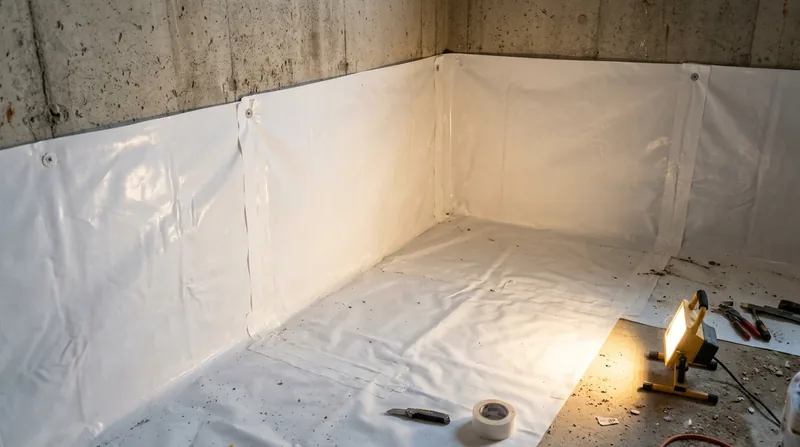




Vapor Barrier Installation in Champaign: Stop Ground Moisture at the Wall
Champaign sits on flat glacial till and silty loam that drains slowly, and the water table climbs every spring under the old bungalows and foursquares of the Old West Side, Garden Hills and Douglass Square. If your basement smells musty in June or the block walls weep after a Boneyard Creek cloudburst, ground moisture vapor is likely moving through the masonry and slab. Vapor Barrier Installation in Champaign puts a heavy-duty sheet across the walls and floor to block that vapor at the source, with sealed seams and taped terminations that hold. We install it as part of a complete basement waterproofing plan, sized to the way your 1920s cut stone or 1960s block actually behaves.
This is below-grade work, done right the first time: no guesswork, no thin plastic stapled to a damp wall.
Why Champaign Basements Sweat: Clay Soil, High Water Table and Old Masonry
The ground here is heavy and slow. Spring snowmelt and summer downpours push the water table up against footings that were never designed for it, and the freeze-thaw cycle works on every mortar joint in the older housing stock. Vapor moves through brick, cut stone and early block whether or not you see a puddle, and that is what drives the musty smell and the white efflorescence bloom on the wall face.
- Slow-draining glacial clay holds moisture against the foundation long after the rain stops.
- Cut stone and soft brick in pre-1940 homes wick vapor inward and show efflorescence within days.
- 1950s to 1970s ranches in Bristol Park and the south side often have partly finished basements where vapor ruins drywall and carpet.
- Spring water table rise is the dominant failure mode here, not coastal humidity or fog.
A proper barrier interrupts that path before it reaches finished materials or stored belongings.
Key info: A homeowner on the Old West Side had efflorescence creeping up a cut stone wall every March and a musty smell by May. The barrier went on after the wall was prepped and the sump basin was tied in, and the wall face stayed dry through the next spring thaw.
For official guidance on basement moisture and moisture control, the EPA mold course is a plain-language reference on how moisture moves through building materials.
How We Install a Vapor Barrier in a Champaign Basement
We start by finding where the water and vapor are actually coming from, because a barrier over an active leak traps the problem instead of solving it. If the wall is taking hydrostatic pressure, we address drainage first, then install the barrier. If a crack is the source, we inject it before the sheet goes up. Then we run the barrier from the top of the wall down and across the slab, seal every seam, tape the terminations and integrate the sump where needed.
- We inspect the walls, slab and footing drain to identify vapor paths and any active seepage.
- We prep the surface, removing loose parging and efflorescence so the sheet sits flat.
- We hang heavy-duty barrier sheets from the top of the wall to the floor, overlapping each run.
- We seal every seam with compatible tape and adhesive and tape all terminations tight.
- We tie the barrier into the sump basin and check valve so any water that reaches the floor drains away.
- We verify the discharge line and grading outside so the system is not fighting a downspout dumping at the wall.
Every install ends with a walkthrough so you know exactly what was sealed and where the system drains.
Key info: In a 1958 split-level off Curtis Road, the barrier was tied to an existing sump with a failed check valve. Replacing the valve and integrating the sheet took one extra hour and stopped the backflow that had been soaking the slab corner.
If your basement also needs perimeter drainage, we coordinate the barrier with an interior drain tile system so the two work as one assembly.
Vapor Barrier Approaches We Use in Champaign Homes
Not every basement needs the same sheet or the same layout. We match the approach to the wall type, the moisture reading and whether the basement is finished, so the barrier performs without trapping water against the masonry.
| Approach | Description | Best for |
|---|---|---|
| Wall and slab sheet barrier | Heavy-duty sheet run from the top of the wall across the floor, seams sealed and taped. | Full basements with vapor on both wall and slab |
| Dimple board drainage mat | Drainage mat holds the barrier off the wall and lets moisture fall to the perimeter drain. | Walls with active seepage and hydrostatic pressure |
| Sump-integrated barrier | Barrier terminates into the sump basin with a check valve on the discharge line. | Basements with an existing or new sump pump |
| Partial wall barrier | Sheet covers the damp lower wall band only, sealed at the top termination. | Basements with limited vapor on the lower courses |
Vapor Barrier Installation Cost in Champaign: What to Expect
Most barrier work in Champaign starts from $3 per square foot, and that figure covers material, surface prep, sealed seams, taped terminations and the sump tie-in where one exists. The number moves with wall height, the amount of loose parging that has to come off, whether the basement is finished, and whether drainage work has to happen first. A simple bungalow wall with good access sits near the low end; a foursquare with bowed walls and an active leak needs more prep and lands higher.
Getting two or three estimates is smart because a barrier is only as good as the prep under it. A low bid that skips surface prep or tapes seams poorly will fail in a season. Ask each contractor what they do about active seepage and how they tie the barrier to the sump. Our pricing overview shows how barrier work lines up with the rest of a waterproofing plan.
Hiring a Vapor Barrier Contractor Near Me in Champaign: What to Check
When you search for a vapor barrier contractor near me in Champaign, the license and insurance question comes first. Ask for the certificate, confirm the company carries general liability and workers compensation, and get the scope in writing before anyone touches the wall. Then check references from homes built in the same era as yours, because a 1925 cut stone wall and a 1968 block wall behave differently.
Permits are commonly required for work that alters drainage or the sanitary connection of a sump discharge, and thresholds vary by jurisdiction, so confirm with the City of Champaign building department before work starts. If you are in a subdivision with HOA rules in Savoy or Mahomet, check those too. Reach out through our contact page and we will walk you through the scope and the paperwork.
Vapor Barrier Installation in Champaign: Pricing Guide
| Service | Price | Details |
|---|---|---|
| Partial wall barrier | Starting at $3/sq ft | Covers the damp lower wall band with sealed top termination and surface prep included |
| Full wall and slab barrier | Starting at $4/sq ft | Heavy-duty sheet from wall top across the floor, all seams sealed and taped |
| Sump-integrated barrier | Starting at $5/sq ft | Barrier terminates into the sump basin with a check valve on the discharge line |
| Barrier with drainage mat | On estimate | Dimple board and prep for active seepage need an on-site look before pricing |
| Travel | Included | In Champaign and surrounding areas, no separate call-out or mileage fee |
| Estimate | Free | Response within 24h at (217) 863-1605, no obligation to book |
Indicative pricing, the exact cost depends on square footage, finish, and site access. Free personalized estimate within 24h at (217) 863-1605.


