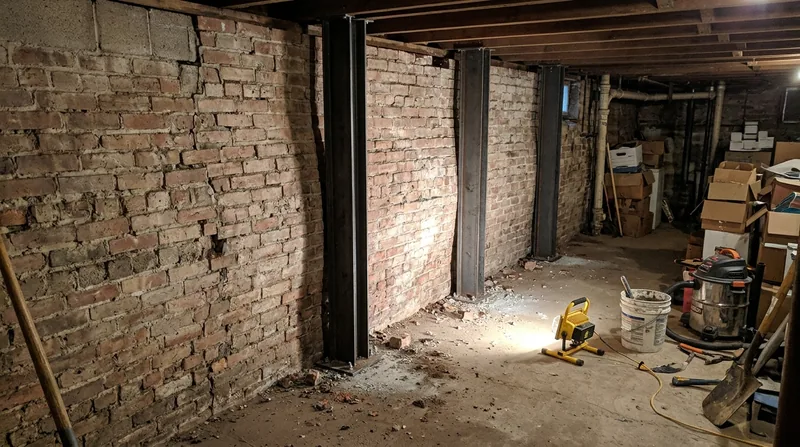




Bowing Wall Repair in Champaign: Stop the Lean Before It Spreads
When a foundation wall starts to lean or bow inward, Bowing Wall Repair in Champaign is the service that keeps that movement from turning into a collapsed wall. Champaign sits on flat glacial till and silty loam that drains slowly, and the water table rides high every spring. That combination pushes hydrostatic pressure against old cut stone, brick, and early block walls in the Old West Side, Garden Hills, and Douglass Square. Freeze-thaw cycles crack the mortar, and the wall starts to move. We stabilize bowing and leaning walls with carbon fiber straps, steel I-beams, or wall anchors, matched to how far the wall has moved and how much wet clay is pressing on it. If you are also seeing water at the wall, start with basement waterproofing so the pressure source gets handled, not just the symptom.
Why Bowing Walls Show Up in Champaign's Older Basements
Most of the bowing walls we see are in 1900s-1930s bungalows and foursquares with full basements built of cut stone, brick, or early block. Those walls were never designed for the hydrostatic pressure that wet glacial clay puts on them each spring. Add snowmelt, a fast summer cloudburst, and the freeze-thaw cycle, and the mortar joints open, the wall face moves inward, and you get efflorescence and horizontal cracking near the middle of the wall. Newer subdivisions in Savoy and Mahomet sit mostly on slabs, so the bowing wall calls concentrate in the older city core.
- You see a horizontal crack near the middle of the wall, which is the classic sign of soil pressure pushing inward.
- You notice the wall leaning in at the top, which often means the floor joists are no longer bearing correctly.
- You find efflorescence, that white chalky powder, where water is moving through the block and evaporating.
- You spot stair-step cracking in the mortar joints at the corners of the basement.
- You feel a gap between the wall and the floor, or the wall has moved more than an inch over a few seasons.
Any one of these is a reason to get the wall looked at before the next spring thaw.
Key info: A foursquare off West Church Street in Champaign had a block wall bowing about 2 inches after the 2023 freeze-thaw cycle. The wall had efflorescence and a horizontal crack at mid-height. We strapped it with carbon fiber and addressed the water with an interior perimeter drain, and the wall has held its position since.
For the code side, foundation structural repair permits in Illinois are issued locally, so confirm requirements with the Illinois Department of Natural Resources and your city building department before work starts. Rules vary by jurisdiction and must be verified.
How We Diagnose and Repair a Bowing Wall in Champaign
We start by figuring out how far the wall has moved and what is pushing it. A bowing wall is a pressure problem first and a structural problem second, so we check the grading, the downspout extensions, and the drain tile before we pick a repair. If the wall is moving but the basement is dry, the fix may be structural only. If water is driving the movement, the structural repair goes in with drainage so the wall is not fighting the same load again.
- We measure the wall deflection with a plumb line and note crack width, efflorescence, and any floor or joist movement.
- We check the exterior grade, downspout discharge, and window wells to see where water is loading the soil.
- We recommend the repair method (carbon fiber straps, steel I-beams, or wall anchors) based on deflection and wall material.
- We pull the permit if the local building department requires one for structural foundation repair.
- We install the anchors or straps, torque them to spec, and patch and parge the wall face where needed.
- We correct the drainage source with an interior perimeter drain or exterior membrane so the pressure does not rebuild.
The goal is a wall that stops moving and a soil load that stops growing.
Key info: A 1950s ranch in Bristol Park had a leaning block wall with a finished basement behind it. We used wall anchors from the exterior so we did not have to tear out the finished side, then tied the repair to a interior drain tile system to relieve the hydrostatic pressure that started the movement.
Repair Methods We Match to the Wall
Not every bowing wall needs the same fix. A hairline lean in a solid brick wall is a different job from a block wall that has moved 2 inches and cracked through. Here is how we match the method to the movement.
| Approach | Description | Best for |
|---|---|---|
| Carbon fiber straps | Straps epoxied to the wall face and anchored top and bottom to stop further inward movement. | Block walls with moderate bowing and no through-wall cracking. |
| Steel I-beams | Vertical beams set against the wall and tied into the floor and joists to brace the wall. | Walls with heavier movement or where the top of the wall is pushing in. |
| Wall anchors | Exterior anchor plates tied through the wall to interior plates, pulled tight to arrest movement. | Leaning walls where the finished side cannot be opened up. |
| Epoxy or polyurethane injection | Injection ports set in the crack and resin pumped in to seal and rebond the crack. | Cracks that are leaking but the wall is not bowing. |
We tell you plainly when simple crack sealing is enough and when the real problem is hydrostatic pressure that needs drainage before structure.
Bowing Wall Repair Cost in Champaign: What to Expect
Bowing wall repair pricing in Champaign starts from $600 for a limited repair such as crack injection or a small strap installation, and climbs from there. What moves the number is how far the wall has moved, the wall material (cut stone and brick cost more to work than block), how many straps or anchors the wall needs, and whether drainage work has to go in at the same time. Access matters too: a finished basement or a tight lot on the Old West Side adds labor. Get two or three written estimates so you can compare the method, not just the number. Our full pricing overview breaks down the ranges by method.
Bowing Wall Repair Near Me: How to Pick a Contractor Near Champaign
Searching for bowing wall repair near me in Champaign turns up general foundation firms, plumbers, and dedicated basement waterproofing specialists, and they are not the same. You want a contractor who reads wall movement and water pressure together, not one who only patches cracks. Ask for proof of licensing and insurance, ask how they will handle the permit, and ask for references from Champaign jobs with the same wall type as yours. If your home is in a historic district or an HOA, confirm any exterior work requirements before signing. Reach out through our contact page to set up an inspection.
- Confirm the contractor is licensed and insured and can provide a certificate on request.
- Get at least two or three written estimates that name the repair method, not just a price.
- Ask for local references from Champaign, Urbana, or Savoy homes with similar wall construction.
- Ask who pulls the permit and whether structural foundation repair requires one in your jurisdiction.
- Check HOA or historic district rules before any exterior anchor or excavation work begins.
A contractor who answers these questions plainly is the one you want holding the wall.
Bowing Wall Repair in Champaign: Pricing Guide
| Service | Price | Details |
|---|---|---|
| Crack injection (epoxy or polyurethane) | Starting at $600 | Includes port installation and resin injection for a leaking non-bowing crack; multiple cracks raise the price. |
| Carbon fiber strap installation | Starting at $1,200 | Includes straps, epoxy, and anchoring for a moderately bowing block wall; strap count drives the total. |
| Steel I-beam or wall anchor system | On estimate | Heavier movement and finished basements need an on-site look before a number is given. |
| Drainage correction with structural repair | On estimate | Interior drain tile or exterior membrane added to relieve hydrostatic pressure; scope varies by wall length. |
| Travel | Included | In Champaign and surrounding areas, no separate call-out or mileage fee. |
| Estimate | Free | Response within 24h at (217) 863-1605, no obligation to book. |
Indicative pricing, the exact cost depends on square footage, finish, and site access. Free personalized estimate within 24h at (217) 863-1605.


