



Basement Waterproofing in Champaign: Built for Prairie Clay and a High Spring Water Table
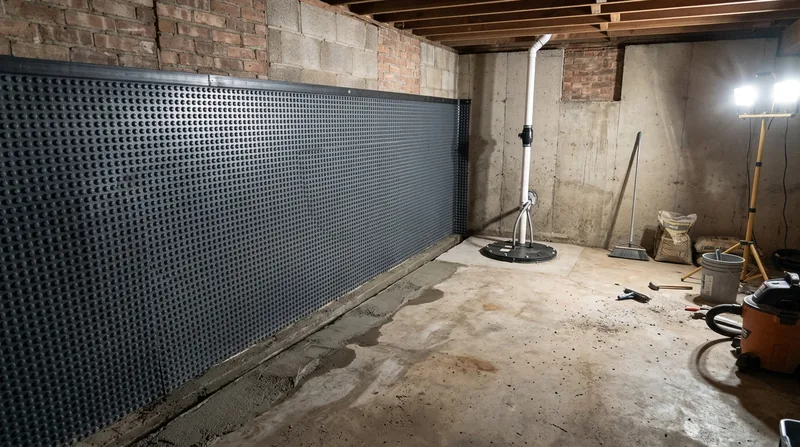
Basement Waterproofing in Champaign starts with one fact most homeowners learn the hard way: this city sits on flat glacial till and silty loam that drains slowly, and the water table climbs every spring. In the Old West Side, Garden Hills and Douglass Square, that means 1900s-1930s bungalows and foursquares with full basements of cut stone, brick or early block take on water at the floor joint and through porous mortar. On the south and east sides and in Bristol Park, 1950s-1970s ranches and split-levels with partly finished basements show the same seepage after a Boneyard Creek cloudburst or a hard freeze-thaw cycle. We trace the actual water path, then build the system that fits the house: interior drain tile, sump pump, wall treatment and vapor barrier. If you are still deciding between approaches, start with our interior drain tile system page to see how the work is sequenced.
Why Wet Basements Are the Norm in Champaign, Not the Exception
The dominant failure mode here is not a single cracked wall. It is hydrostatic pressure at the footing, where saturated prairie clay pushes against a foundation that was never designed for a spring water table this high. Water finds the weakest point: the cove joint where the wall meets the floor, the mortar joints in old brick, the block cores in a 1960s ranch. Efflorescence on the wall face is the tell that moisture has been moving through the masonry for years, long before the first puddle showed up.
- Old West Side and Garden Hills homes seep through cut stone and brick mortar that has softened over a century of freeze-thaw cycles.
- Bristol Park and south-side ranches collect water at the floor joint because the original footing drain has silted shut.
- Savoy and Mahomet subdivisions on slabs push basement work toward the older housing stock, where full basements actually exist.
- Boneyard Creek rises fast in summer cloudbursts, and downspouts that dump within three feet of the wall send that surge straight into the soil at the footing.
If you see efflorescence, a musty smell or water after rain, the cause is almost always below grade and it will not seal itself.
Key info: A 1920s foursquare off Church Street in Champaign had water only at the floor joint every March. The wall itself was sound. The fix was an interior perimeter drain tied to a new sump basin, not exterior excavation. The homeowner had already paid twice for crack sealing that never addressed the pressure.
Permits for structural foundation work and drainage alterations vary by jurisdiction, so verify requirements with the City of Champaign building department before work begins.
How We Waterproof a Champaign Basement, Step by Step
We start with a free inspection that walks the basement perimeter, reads the wall for efflorescence and crack patterns, checks the floor joint and tests how the sump basin behaves during a draw. Then we decide whether the problem is simple crack seepage or real hydrostatic pressure. That distinction decides everything: a hairline vertical crack gets epoxy or polyurethane injection, while a wet floor joint around the whole perimeter gets an interior drain tile system. We do not sell excavation when a drain solves it.
- We map the water path from the gutter discharge and grading down to the footing, because most seepage starts above grade.
- We cut a channel along the interior perimeter and set drain tile in washed stone, pitched to the sump basin.
- We install the sump pump with a check valve and a discharge line that exits well away from the foundation.
- We seal active cracks by injection and treat the wall with a waterproof membrane or dimple board where the wall face stays damp.
- We backfill the channel with concrete and leave the basement ready for finishing.
Most jobs run two to four days, and we test the system with water before we call it done.
Key info: In a 1958 split-level in Bristol Park, the original weeping tile had collapsed under silt. We replaced it with an interior perimeter drain, added a sump pump installation and ran the discharge to a dry well. The basement had been wet every spring for a decade.
Waterproofing Methods We Use on Champaign Foundations
No single method fits every house on this flat prairie. A 1920s brick foundation and a 1970s block wall fail differently, and the water table behaves differently in Savoy than it does near Boneyard Creek. Here is how the main approaches compare for local housing stock.
| Approach | Description | Best for |
|---|---|---|
| Interior drain tile | Perimeter channel cut inside the footing, drained to a sump basin | Wet floor joints and hydrostatic pressure in finished basements |
| Exterior waterproofing | Excavation to the footing, membrane and dimple board, new footing drain | Bowing walls and failed exterior drain tile on old brick foundations |
| Crack injection | Epoxy or polyurethane forced through injection ports into the crack | Isolated vertical cracks with no perimeter seepage |
| Wall sealing and vapor barrier | Membrane or dimple board over damp masonry, sealed at the floor joint | Damp walls, efflorescence and musty basement smell |
| Sump and battery backup | Primary pump plus battery backup on the same discharge line | Spring storms and power outages during a high water table |
We match the method to the failure, not to a sales target, and we will tell you when simple crack sealing is enough.
Basement Waterproofing Cost in Champaign: What to Expect
Most Champaign basement waterproofing projects start at From $2,500 for a focused repair such as crack injection or a partial perimeter drain with a sump pump. A full interior drain tile system around a 1,000 square foot basement with a new sump basin typically lands higher, and exterior excavation on an old brick foundation sits at the top of the range because it involves digging to the footing and rebuilding the drain. The number moves with basement size, wall material, how much of the perimeter is wet, and whether the discharge line has somewhere legal to go.
Three factors drive the price more than anything else on this flat clay ground: whether the problem is isolated seepage or full hydrostatic pressure, whether the old footing drain has to be replaced, and how accessible the perimeter is once the basement is finished. A house in Philo with an unfinished basement is a different job from a finished basement in Savoy. We give you a written scope before any work starts, and we recommend getting two or three estimates so you can compare scope, not just the bottom line. Our full pricing overview breaks down the ranges by system.
Choosing a Basement Waterproofing Contractor Near Me in Champaign
Ask for proof of licensing and insurance before anyone cuts concrete, and get a certificate of insurance sent directly from the carrier. Ask whether the company specializes in below-grade work or treats waterproofing as a sideline to general foundation repair. Ask for references from Champaign addresses with the same housing stock as yours, because a 1920s brick foundation and a 1970s block wall need different answers. And ask who pulls the permit if the job touches structural repair or alters drainage.
- Confirm the license and insurance are current and match the company name on the estimate.
- Get two or three written estimates with the same scope so the comparison is honest.
- Ask for local references and, when possible, a look at a completed job.
- Verify permit requirements with the City of Champaign building department before signing.
A contractor who explains why your basement leaks, rather than just quoting a system, is the one worth hiring. Reach us through the contact page to schedule a free inspection at (217) 863-1605.
Basement Waterproofing in Champaign: Pricing Guide
| Service | Price | Details |
|---|---|---|
| Crack injection (epoxy or polyurethane) | Starting at $2,500 | Includes injection ports, sealing and cleanup for isolated vertical cracks; price rises with crack length and count |
| Interior drain tile with sump pump | Starting at $4,500 | Perimeter channel, washed stone, sump basin and pump; basement size and finish level move the price |
| Exterior basement waterproofing | On estimate | Excavation to footing, membrane, dimple board and new drain; depth and access decide the number |
| Sump pump replacement with battery backup | Starting at $1,200 | New primary pump, check valve, discharge line and backup unit; discharge routing affects the total |
| Travel | Included | In Champaign and surrounding areas, no separate call-out or mileage fee |
| Estimate | Free | Response within 24h at (217) 863-1605, no obligation to book |
Indicative pricing, the exact cost depends on square footage, finish, and site access. Free personalized estimate within 24h at (217) 863-1605.


