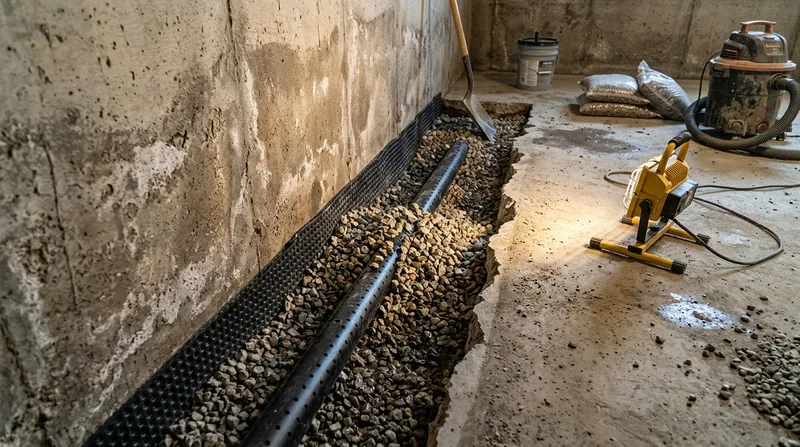




Champaign sits on flat glacial till and silty loam that drains slowly, and the water table runs high every spring. In the Old West Side, Garden Hills, and Douglass Square, 1900s to 1930s bungalows and foursquares sit on full basements of cut stone, brick, or early block that were never built to shed groundwater. When Boneyard Creek rises fast in a summer cloudburst, or snowmelt and freeze-thaw cycles open old wall joints, that water has nowhere to go but under the slab and against the footing. An Interior Drain Tile System in Champaign captures that water at the footing, channels it to a sump basin, and pumps it out before it reaches your floor. We install interior perimeter drain systems for homeowners across Champaign and the surrounding prairie towns, and we can do the work in any season. If you are still sorting out whether you need interior drainage or a different repair, start with our basement waterproofing service page for the full picture.
Why Interior Drain Tile Matters in Champaign's High Water Table
Most wet basements in Champaign are not a crack problem. They are a hydrostatic pressure problem. The soil under the slab is saturated, the water table pushes up, and water finds the path of least resistance at the cove joint where the wall meets the floor. Sealing that joint from the inside buys time, but it does not relieve the pressure behind it.
- Spring snowmelt and heavy rain raise the water table fast on the flat prairie, and the silty loam releases that water slowly.
- Old cut stone and brick foundations in the Old West Side absorb water and show efflorescence and white bloom on the block.
- 1950s to 1970s ranches in Bristol Park and on the south and east sides often have partly finished basements where water damages framing and drywall.
- Original weeping tile and footing drains installed decades ago are frequently collapsed, root-filled, or clogged with clay.
- A sump pump that runs constantly in spring is a sign the basin is doing all the work and the perimeter has no drain.
An interior perimeter drain relieves that pressure across the whole footing, not just at one crack, and it keeps working through every freeze-thaw cycle the prairie throws at the house.
Key info: A homeowner on a 1920s foursquare near West Side Park called us after every heavy rain left a quarter inch of water along the west wall. The block was dry above grade and showed no structural crack. The water was coming up at the cove joint, driven by the spring water table, and an interior drain tile system along that footing was the correct fix, not another coat of sealer.
Before you commit to any approach, check what your local building department requires for drainage work. The City of Champaign can confirm permit thresholds, and rules vary by jurisdiction.
How We Install an Interior Drain Tile System in Champaign
We work from the inside, so we do not excavate your yard, tear up landscaping, or dig down the outside of the foundation. The process is methodical and the basement stays usable when we leave. Here is the sequence we follow on a typical Champaign job.
- We inspect the basement, the footing, the wall joints, and the existing sump setup, and we identify where water is actually entering.
- We set up plastic sheeting and negative air containment so concrete dust stays out of the finished part of the basement.
- We cut a channel along the perimeter of the slab, about 12 inches wide, down to the footing.
- We lay perforated drain tile in washed gravel along the footing, with the holes facing down to catch water at the lowest point.
- We tie the perimeter run into a new sump basin set into the floor at the low corner of the basement.
- We install the sump pump, check valve, and discharge line, and we route the discharge to a legal point of release.
- We cover the gravel with filter fabric, then pour new concrete to match the existing floor.
If your existing drain tile is failing rather than missing, our drain tile repair and replacement service covers that route, and we will tell you honestly which one your basement needs.
Key info: A split-level in Savoy had a finished basement with carpet and a drop ceiling. We cut the perimeter channel, ran the new tile to a sump basin in the mechanical corner, and re-poured the floor in two days. The homeowner kept the finished room, and the spring water that used to seep under the baseboard now goes to the pump.
Interior Drain Tile Methods We Use and When Each Fits
Not every basement gets the same drain detail. The right method depends on the footing depth, the wall material, and how the floor was poured. Here is how the main approaches compare.
| Approach | Description | Best for |
|---|---|---|
| Full perimeter drain tile | Perforated tile in gravel runs along the entire footing and ties into a sump basin. | Wet walls on multiple sides and a high spring water table. |
| Partial run drain tile | Tile is installed only along the wet wall or walls and tied to the existing sump. | One-sided seepage in a basement with a working sump already in place. |
| Drain tile plus dimple board | Dimple board is added against the wall to guide wall seepage down to the new tile. | Old brick and cut stone walls that weep through the block itself. |
| Drain tile plus vapor barrier | A sealed vapor barrier is added over the floor and walls to control moisture. | Finished basements where moisture control and prevention of mold growth matter. |
| Drain tile plus battery backup | A battery backup sump pump is added so the system keeps pumping in a power outage. | Homes that lose power during summer storms, when the pump is needed most. |
We recommend the method after we see the footing and the wall, not before, because a partial run on a basement with a saturated perimeter just moves the problem to the next wall.
Interior Drain Tile System Cost in Champaign: What to Expect
Interior drain tile pricing starts at From $50 per linear foot for a standard perimeter run, and most Champaign basements fall in a range that reflects the actual footage, the wall condition, and the sump work. A 1920s bungalow in Douglass Square with a short perimeter and a simple sump sits near the low end. A large split-level in Mahomet with a finished basement, thick slab, and a long run to the discharge point sits higher.
Several factors move the number. Footage is the biggest one, since you pay by the linear foot of footing covered. Slab thickness and whether there is a finished floor to protect add labor. Old cut stone or brick walls that need dimple board or parging add material and time. A new sump basin, pump, and discharge line are part of the job, and a battery backup adds to it. Access matters too: a basement with a narrow stair and a finished ceiling takes longer to work in than an open, unfinished one.
Get two or three written estimates and compare the scope, not just the total. A low number that skips the sump basin, the filter fabric, or the concrete pour is not the same job. Our pricing overview lays out the line items so you can compare bids on equal footing.
Interior Drain Tile System Near Me: Hiring a Contractor Near Champaign
You want a contractor who has cut a channel in a 1930s Champaign basement before, not one learning on your footing. Ask direct questions and expect direct answers. A waterproofing specialist should be able to explain why an interior system fits your basement and when exterior work would be the better call.
- Confirm the contractor is licensed and insured, and ask for a certificate of insurance before work starts.
- Get at least three written estimates and make sure each one lists the sump basin, pump, discharge, and concrete pour.
- Ask for references from Champaign or Urbana homeowners with a basement similar to yours, and call them.
- Ask who pulls the permit if your jurisdiction requires one for drainage or sump discharge work, and verify the threshold with the local building department.
- Check for a transferable warranty in writing, and read what it covers and for how long.
If a contractor will not put the scope and the warranty in writing, keep looking. You can reach us through our contact page to set up a free basement inspection and get a straight answer on what your basement needs.
Interior Drain Tile System in Champaign: Pricing Guide
| Service | Price | Details |
|---|---|---|
| Full perimeter interior drain tile | Starting at $50/linear ft | Includes channel cut, perforated tile in gravel, filter fabric, and concrete re-pour along the full footing. |
| Partial run interior drain tile | Starting at $50/linear ft | Covers the wet wall or walls only and ties into an existing sump basin already in place. |
| Drain tile with new sump basin and pump | On estimate | Adds basin excavation, pump, check valve, and discharge routing; price depends on discharge point. |
| Drain tile with dimple board or vapor barrier | On estimate | Adds wall membrane or sealed vapor barrier; driven by wall material and finished basement condition. |
| Travel | Included | In Champaign and surrounding areas, no separate call-out or mileage fee. |
| Estimate | Free | Response within 24h at (217) 863-1605, no obligation to book. |
Indicative pricing, the exact cost depends on square footage, finish, and site access. Free personalized estimate within 24h at (217) 863-1605.


