



French Drain Installation in Champaign: Keeping Water Away From Your Foundation
Champaign sits on some of the flattest ground in Illinois, a wide prairie of glacial till and silty loam that drains slowly and holds the spring water table high. In the Old West Side and Garden Hills, 1900s bungalows and foursquares sit over full basements of cut stone, brick, and early block, and when Boneyard Creek rises after a summer cloudburst, that water has nowhere to go but down along the foundation. French Drain Installation in Champaign is the below-grade fix for exactly this problem: a graded gravel and pipe system that intercepts groundwater before it reaches the wall.
We install exterior perimeter drains along the footing, wrap them in filter fabric, and tie them to daylight or a sump basin depending on the lot. If you are still diagnosing where the water is coming from, start with a free basement inspection so we can trace the path before anyone digs.
Why Flat Lots and High Spring Water Make Drains Essential in Champaign
On flat prairie ground, surface water does not run off quickly. It ponds, soaks in, and pushes against the foundation as hydrostatic pressure. The older homes in Douglass Square and the south and east sides of Champaign were built before modern footing drains, and their original weeping tile is often collapsed, clogged with silt, or simply gone. When that happens, water finds the path of least resistance: through the cove joint, through hairline cracks, and up through the floor.
- Glacial clay soil drains slowly, so a heavy rain sits against the wall for days instead of running away.
- Boneyard Creek and the high spring water table raise the water level around footings in the older core neighborhoods.
- Freeze-thaw cycles crack old brick and stone walls and open joints that let water through.
- Downspouts that discharge too close to the house concentrate roof water right at the corner of the foundation.
- Original drain tile from the 1920s and 1930s has often failed or silted shut, leaving no outlet for groundwater.
A properly built French drain gives that water a controlled path away from the wall instead of through it.
Key info: A foursquare on the Old West Side with a cut stone foundation and no working footing drain will typically show efflorescence and damp patches along the lower wall every March and April. That pattern points to groundwater, not a single crack, and a perimeter drain is the right answer.
For official guidance on drainage and grading rules that apply to residential work, check the City of Champaign planning and development pages before you schedule any excavation: City of Champaign.
How We Install a French Drain on a Champaign Foundation
Every job starts with locating the actual water source, not guessing. We walk the basement, check the wall for efflorescence and seepage lines, probe the grading, and look at where the downspouts land. On a flat lot we also check whether daylight discharge is even possible, because many Champaign properties need to tie into a sump basin instead.
- We mark the excavation line along the foundation and call for utility locates before any shovel touches the ground.
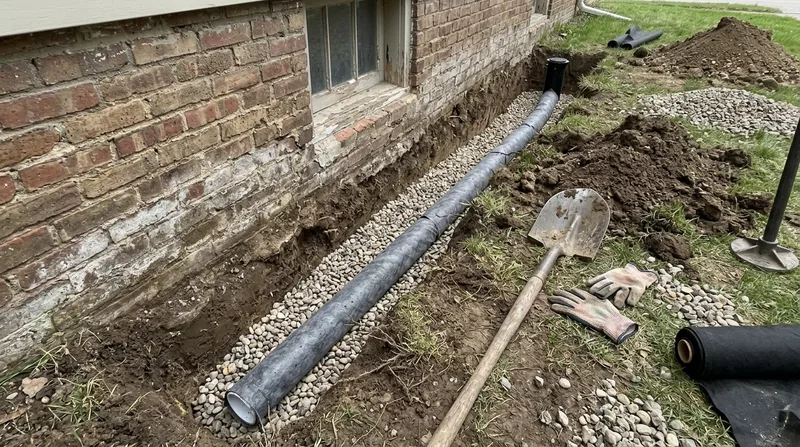
- We excavate down to the footing, expose the wall, and remove failed or collapsed original drain tile.
- We clean and parge the wall, then apply a waterproof membrane and dimple board where the scope calls for it.
- We lay perforated pipe in a washed gravel bed, wrap the whole assembly in filter fabric, and grade the gravel so water flows to the outlet.
- We tie the drain to daylight on a sloped lot or into a sump basin with a check valve and discharge line on a flat lot.
- We backfill with graded material, restore the surface, and extend downspouts well away from the foundation.
The result is a drain that intercepts water at the footing instead of letting it sit against the wall.
Key info: In Savoy and Mahomet, many newer homes sit on slabs with no basement, so the basement drain work concentrates in the older Champaign neighborhoods. A 1950s ranch in Bristol Park with a partly finished basement is a typical candidate: the original footing drain has silted shut, and the finished side of the basement shows damp along the bottom plate every spring.
If the wall itself is bowing or has a structural crack, a drain alone will not fix it. Pair the drainage work with foundation crack repair so the wall is stabilized and the water is managed at the same time.
French Drain Approaches We Use in Champaign
Not every lot calls for the same system. The right choice depends on the grading, the depth to footing, whether daylight is available, and how the basement is finished. Here is how the main approaches compare.
| Approach | Description | Best for |
|---|---|---|
| Exterior footing drain to daylight | Perforated pipe in washed gravel along the footing, fabric wrapped, discharged to a lower grade point on the lot. | Lots with enough slope to move water away by gravity. |
| Exterior footing drain to sump basin | Same gravel and pipe assembly, but the drain empties into a sump basin with a pump and check valve. | Flat prairie lots where daylight discharge is not possible. |
| Interior perimeter drain | Channel cut along the inside of the footing, leading to a sump basin, with the floor restored over it. | Finished basements and cases where exterior excavation is impractical. |
| Drain tile repair and spot replacement | Replacing collapsed or silted sections of original weeping tile and reconnecting them to a working outlet. | Older homes where most of the original drain is still serviceable. |
| Surface and downspout correction | Regrading the soil slope and extending downspouts so roof water never lands next to the wall. | Homes with a working drain but concentrated surface water at the corners. |
We recommend the approach that matches the actual water source, not the one that is easiest to sell.
French Drain Installation Cost in Champaign: What to Expect
French drain pricing is driven by linear footage, depth of excavation, access, and how the water is discharged. As a starting point, expect From $25/linear ft for a standard exterior run in accessible ground. That figure moves quickly when the job requires hand digging along a tight property line, deep excavation to reach a footing, removal of old concrete, or a sump basin and pump on a flat lot with no daylight option.
Access matters more than most homeowners expect. A narrow side yard in the Old West Side where equipment cannot fit means hand excavation, and that changes the labor. A long run along the back of a ranch in Bristol Park is faster. The discharge method is the other big variable: gravity to daylight is cheaper than a sump basin with a pump, check valve, and discharge line.
Get two or three written estimates that spell out the linear footage, the pipe and gravel spec, the fabric, the discharge method, and what happens to the surface afterward. A low number that skips the gravel bed or the fabric wrap is not a bargain. You can see how our line items are structured on the pricing page.
What to Look For in a French Drain Contractor Near Me in Champaign
Hiring for below-grade work is different from hiring for surface work, because once the trench is backfilled you cannot see what was done. Ask for proof of licensing and insurance before anyone walks the property, and get a certificate of insurance sent directly from the carrier. Ask how many drainage systems the crew has installed in Champaign County and whether they handle the sump and discharge side in-house.
Check references from jobs at least two years old, ideally in the same kind of housing stock you own. Ask whether the contractor pulls the required permits for work that alters drainage or the sanitary connection of a sump discharge. Rules vary by jurisdiction, so confirm the current requirements with the City of Champaign building department before work begins. If you are in an HOA, get the drainage plan approved in writing first.
Reach out through our contact page to schedule an on-site look.
French Drain Installation in Champaign: Pricing Guide
| Service | Price | Details |
|---|---|---|
| Exterior French drain, standard access | From $25/linear ft | Includes excavation, washed gravel, perforated pipe, and filter fabric wrap along the footing. |
| Exterior drain with sump basin and pump | From $45/linear ft | Adds sump basin, pump, check valve, and discharge line for flat lots without daylight. |
| Interior perimeter drain | From $40/linear ft | Channel cut along the footing with floor restoration, suited to finished basements. |
| Drain tile repair and spot replacement | From $1,800 | Replaces collapsed or silted sections of original weeping tile and reconnects to outlet. |
| Complex or large-scale job | On estimate | Hand digging, tight side yards, deep footings, or concrete removal need an on-site look first. |
| Estimate | Free | No obligation, response within 24 hours at (217) 863-1605. |
Indicative pricing, the exact cost depends on square footage, finish, and site access. Free personalized estimate within 24h at (217) 863-1605.


