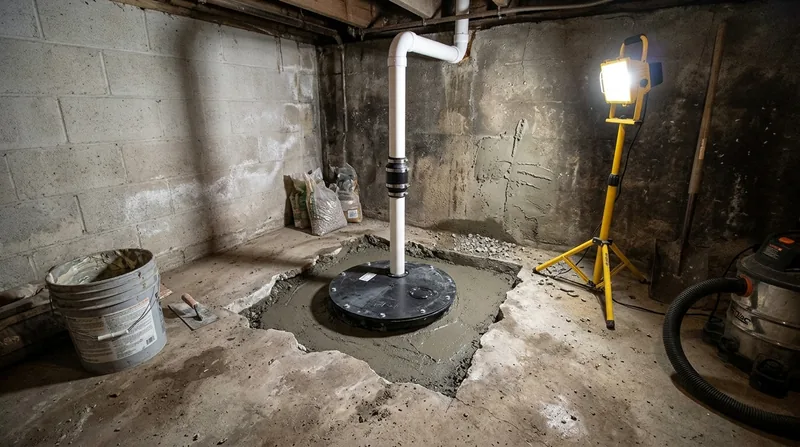




Champaign sits on flat glacial till and silty loam that drains slowly, and the water table climbs every spring across the old bungalows and foursquares of the Old West Side, Garden Hills and Douglass Square. Those 1900s to 1930s full basements were dug with cut stone, brick or early block, and many still rely on a tired footing drain or a sump pit that was never sized for what Boneyard Creek throws at it in a summer cloudburst. Sump Pump Installation & Replacement in Champaign is the work that keeps that water moving out instead of pooling at the wall. We build new pits, swap burned-out pumps and correct discharge lines that dump water back against the foundation. If you are already fighting seepage, start with our basement waterproofing service and we will tell you honestly whether the pump alone is the fix.
Why Champaign Basements Flood and Why the Sump Pump Is the First Line
The dominant failure in this city is not a single cracked wall, it is slow-draining glacial clay soil and a high spring water table pushing hydrostatic pressure against old cut stone and brick. Water finds the path of least resistance, and if the sump pump is undersized, sitting in an unsealed pit or cycling on a clogged intake, the basin overflows and the floor is wet by morning. In the 1950s to 1970s ranches of Bristol Park and the south and east sides, a partly finished basement means a failed pump costs flooring and drywall, not just a mop-up.
- A pump that runs constantly and still leaves water is usually undersized for the inflow, not broken.
- An unsealed basin lets silt and gravel in, which chews the impeller and shortens pump life.
- A missing or stuck check valve sends water back down the discharge line on every cycle.
- A discharge line that ends two feet from the wall recycles the same water into the same soil.
- Spring snowmelt and summer cloudbursts on the open prairie are when pumps fail, because that is when they work hardest.
We size the pump to the inflow we actually see, seal the basin and route the discharge so it does not undo the work.
Key info: A homeowner in Garden Hills called us after every heavy rain with an inch on the floor. The pump was fine. The discharge line ran into a buried corrugated pipe that had crushed under the lawn, so the pump was pushing water into a dead end and burning out the motor. Replacing the pump alone would have failed again within a season.
If you want to check the rules before we start, the City of Champaign building department is the authority on permits and on how a sump discharge connects.
How We Install or Replace a Sump Pump in Champaign Homes
We start by watching the water, not by quoting a pump. On a flat prairie lot the inflow rate during a storm tells us more than any label on the old unit. We check the basin for silt, test the check valve, trace the discharge line to its outlet and look at the grading and downspout extensions that feed the problem. Only then do we pick the pump and the pit.
- We inspect the existing basin, pump, check valve and discharge line and note what is undersized or clogged.
- We cut and set a new sump basin at the low point of the basement floor, sized for the pump and sealed against silt.
- We install a properly sized submersible pump with a check valve and a lid that keeps debris and humidity out.
- We run the discharge line to a freeze-protected outlet that carries water away from the foundation, not back into it.
- We test the float and the full cycle with water before we call the job done.
When the pump is fighting a wet wall rather than a wet floor, the honest answer is often an interior drain tile system that collects water at the footing before it reaches the slab.
Key info: A 1960s ranch in Savoy had a pump in a bare gravel pit with no lid. Every storm washed silt into the basin, and the float jammed twice in one spring. A sealed basin and a correctly sized pump ended the cycle. Newer subdivisions there are often built on slabs, so the basement work concentrates in the older homes, but a slab home with a below-grade mechanical pit still needs the same discipline.
Sump Pump Approaches We Use and When Each One Fits
Not every wet basement needs the same pump and pit. What we install depends on the inflow, the age of the foundation and whether the water is coming through the floor or the wall. These are the approaches we use most in Champaign.
| Approach | Description | Best for |
|---|---|---|
| New sump pit and pump | Cut and set a sealed basin at the low point, with a sized submersible pump and check valve. | Older bungalows with no pit or a bare gravel hole. |
| Pump replacement only | Swap a burned-out or undersized pump into a sound, sealed basin and test the float. | Basins that are intact but the motor is done. |
| Discharge line correction | Reroute to a freeze-protected outlet that carries water away from the foundation. | Pumps that recycle water or freeze at the outlet. |
| Sealed basin and lid | Lid and gasket that keep silt, debris and humidity out of the pit. | Gravel pits that jam the float with silt. |
| Battery backup | Secondary pump on battery power for storm outages. | Homes that lose power in summer storms. |
We match the approach to the failure we find, and we say plainly when a simple pump swap is enough and when the water is really coming through the wall.
Sump Pump Installation & Replacement Cost in Champaign: What to Expect
Most sump pump work in Champaign starts from $1,200, and that figure covers a straightforward replacement into a sound basin with a correctly sized pump, check valve and a tested discharge. A new pit cut into the floor, a sealed lid, a long discharge run or a battery backup moves the number up. Access matters too: a finished basement with carpet and a tight mechanical corner takes more care than an open floor.
Pump capacity, basin depth, discharge routing and whether the old line has to be dug out are the four factors that swing the price most. Two or three estimates on the same scope is the smart move, and any contractor who quotes a pump without looking at the discharge line is guessing. Our full pricing overview breaks down the ranges.
What to Look For When Hiring a Sump Pump Contractor Near Me in Champaign
Ask for the license and the insurance certificate before anyone touches the floor, and do not accept a verbal yes. Ask whether the quote includes a check valve, a sealed lid and a tested discharge, or whether those are add-ons later. Call two references on jobs at least a year old and ask if the basement stayed dry through the following spring.
Permits are commonly required when work alters drainage or the sanitary connection of a sump discharge, and the rules vary by jurisdiction, so confirm with the City of Champaign building department before the work starts. If your home sits in an HOA, check the rules on discharge outlets and exterior line routing first. You can request a free estimate and we will walk the basement with you and put the scope in writing.
Sump Pump Installation & Replacement in Champaign: Pricing Guide
| Service | Price | Details |
|---|---|---|
| Pump replacement only | Starting at $1,200 | New sized submersible pump, check valve and full cycle test into a sound existing basin. |
| New sump pit and pump | Starting at $1,850 | Cut and set a sealed basin at the low point, with pump, lid and discharge. |
| Discharge line correction | Starting at $450 | Reroute to a freeze-protected outlet that carries water away from the foundation. |
| Battery backup add-on | Starting at $650 | Secondary pump on battery power for storm outages, installed alongside the primary. |
| Complex or large-scale job | On estimate | Finished basements, long discharge runs or crushed buried lines need an on-site look first. |
| Estimate | Free | Response within 24h at (217) 863-1605, no obligation to book. |
Indicative pricing, the exact cost depends on square footage, finish, and site access. Free personalized estimate within 24h at (217) 863-1605.


